

Emerging market returns have historically come from many sources - technology, manufacturing, domestic consumption, financial inclusion, logistics or healthcare-related businesses among many others. That breadth is one of the attractions of our asset class. Yet the arithmetic of the emerging markets index suggests this breadth has narrowed considerably. This is not the first time this has happened. The index has become concentrated before, in Mexico in the 1990s before the peso crisis and in China in the late 2010s before the subsequent implosion of the property market.
Today, concentration is appearing less in one country than in one industry: semiconductors. As of June this year, Taiwan accounted for 25% of the index, with roughly 7 of every 10 cents invested landing in just three countries: Korea, Taiwan and China. Three companies in the index are each larger, or almost larger, than the whole of the Indian stock market, despite India being home to 1.4 billion people. Where once the index presented a varied shopping basket, it has quietly become a much narrower exposure to the future demand for semiconductors. A similar exposure is increasingly present in developed market indices, reducing diversification for global asset owners. The arithmetic of generating compounding returns from a trillion-dollar base is demanding, and the more crowded an area of the market becomes, the more carefully we must think about prospective returns.
To continue to find acceptable long-term returns, we have therefore been looking elsewhere for businesses that make a few more cents, rand or naira from a person opening their first bank account, visiting their first formal supermarket, or reaching into a fridge for their first cold soft drink. This note highlights three African and Africa-linked businesses that represent around 10% of our strategy. All three came from our watchlist: a valuation-agnostic list of companies that we believe have the quality attributes required for long-term ownership.
To graduate from our watch list to the portfolio, the companies must pass our assessment of value and only those that we believe present reasonable returns do so. The list reaches across the emerging world and reminds us not to let the index dictate where future returns must originate. What matters is finding businesses with the same long-term characteristics we see in Shoprite, which is helping to formalise how Africans buy their groceries, Standard Bank, the continent’s pre-eminent franchise in deposit taking, payments and corporate banking, and Coca-Cola Hellenic, through which we participate in the continued growth of one of the world’s strongest consumer brands.
Shoprite: Local scale, world-class execution
Shoprite, founded in 1979, is Africa’s largest supermarket retailer. It has spent years turning scale, logistics, data and customer trust into advantages that weaker competitors are struggling to match. In a 2024 company meeting Shoprite described itself as a logistics business, delivering more than 7 billion items a year, with trucks covering around 7 million kilometres a day. Management also noted that around 75% of South Africa’s adult population holds a Shoprite loyalty card1. Competition has been intense and included many talented leaders and even America’s Walmart.
But over time Shoprite has pulled further ahead through consistent execution and a commitment to providing value to its customers. The company’s investment in ecommerce shows why this is more than a traditional supermarket story. Sixty60 is Shoprite’s on-demand grocery delivery service, named because customers can order in around 60 seconds and receive groceries in around 60 minutes. In a 2025 company meeting, management noted that Sixty60 was handling around 1 million orders a week and had an estimated 8% share of South African ecommerce2.
Management first tried a centralised fulfilment model, then changed course when the economics did not work. The store estate became the advantage. Around 90% of the population is within 5km of a Shoprite store, allowing the company to pick from stores, add dark stores selectively and use infrastructure it already owns. That gives Shoprite capabilities that would compare well with many developed -market retailers.
Ecommerce revenue has grown tenfold since 2021 to around ZAR19 billion, or roughly 9% of supermarket sales3. More importantly, Sixty60 gives Shoprite a platform for pharmacy, pet products, general merchandise and financial services. The opportunity is that the market sees Shoprite as a mature South African grocer. We think that may be too narrow a view. Shoprite is using local scale to widen its addressable market. In a demanding operating environment, it has built a digital and logistical capability that is world -class, not merely locally successful. If that capability continues to expand the opportunity set, the current valuation may not fully reflect the growth it can deliver.
Standard Bank: Saving for Africa
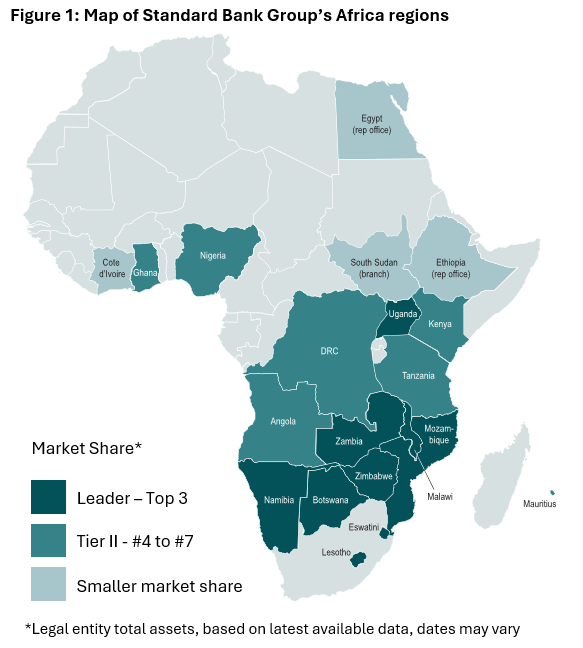
Standard Bank is one of a small number of institutions helping build the financial infrastructure through which African economies save, borrow, transact, trade and invest. Its roots in Africa go back to 1862, when it was founded in Port Elizabeth to finance trade in the Cape Colony4. Over time, it helped finance the diamond and gold industries and became one of southern Africa’s leading financial institutions. The bank’s current growth strategy continues its long history of financing trade, supporting businesses and building the banking relationships that allow economies to formalise and grow. Today, that role extends across much of sub-Saharan Africa through what the bank calls its Africa Regions business. The Africa Regions business segment operates across 20 sub-Saharan countries, with a combined population of over 800 million people and an estimated nominal GDP of $1 trillion5. It has been key for both asset and importantly profit growth for the bank.
Announced results in 2025 showed Africa Regions contributed 42% of group headline earnings, up from just 10% in 2007 and now at the same level as South Africa. These earnings come with a return on equity well above the group average and better growth.
Diversification improves resiliency of returns and much of the profit growth comes from serving large national and multinational corporates, holding short - term government securities, building low-cost deposit franchises and developing pensions and investment businesses. Standard Bank is using brand, balance sheet strength, local knowledge and relationships to serve customers that weaker or less connected institutions may struggle to bank on the same terms. This can be evidenced by the fact that a third of deposits and net loans are denominated in US dollars, demonstrating the calibre of the client base6. A wave of international entrants has come and gone while they have remained in situ developing an unrivalled pan-African footprint.
The South African business remains foundational to the long-term investment case. It is not the fastest - growing part of the group, but it provides scale, capital depth and institutional credibility. Standard Bank is the largest of the South African banks by assets, with a meaningful domestic profit base and a particularly strong position in corporate and investment banking.
 Source: Standard Bank Group FT25 Africa Regions Investor Pack
The business has an outsized share of this more profitable corporate and investment banking profit pool, with around 49% share compared with roughly 25% retail deposit share7. Balance sheet size and reach matter in this part of banking and it is a strength that it appears able to export to sub-Saharan Africa.
South Africa itself remains a difficult economy, but it still has deep financial markets, strong banking regulation, developed infrastructure relative to much of the continent and a large corporate base. For Standard Bank, the South African business is therefore both a source of earnings and a platform from which to serve broader African trade, capital and corporate activity. The investment case does not require a heroic forecast for Africa. It rests on Standard Bank continuing to serve stronger customers, build local deposit franchises, deepen long-term corporate relationships and allocate capital into markets where returns remain structurally higher. There will be currency, credit and sovereign risks along the way. But if Standard Bank can keep compounding book value, paying growing dividends and earning mid-to-high-teens returns on equity, while Africa Regions continues to gain scale, it has the characteristics of a long-term compounder hiding inside what many investors still see as a South African bank. Importantly the shares are liquid, which has hindered direct investment into local African markets over the past 10–15 years.
Coca-Cola Hellenic: Beyond local listings
Coca-Cola Hellenic shows why place of listing can be a poor guide to the source of growth. The company is headquartered in Switzerland and listed in London, but its growth opportunity is increasingly tied to African consumption. This is not a new direction for the company. The business traces part of its history to Nigerian Bottling Company, established by A.G. Leventis in Lagos in 1951. It also has roots in Hellenic Bottling Company, established in Greece in 19698. That combination helps explain the modern business. Coca-Cola Hellenic is a bottler shaped by family ownership, Coca-Cola system relationships and decades of operating across markets with very different income levels and risks.

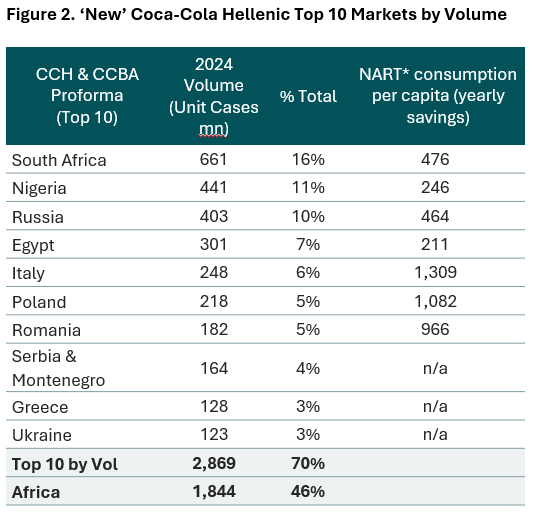
The proposed acquisition of Coca-Cola Beverages Africa is a major step for the business. It would add 14 African markets to Coca-Cola HBC’s existing operations in Nigeria and Egypt; and would make the group responsible for around two-thirds of Africa’s total Coca-Cola system volume after completion9. The investment case is not simply that Africa’s young population automatically creates shareholder returns. It does not. The case is that a strong bottler can turn that opportunity into economics through manufacturing, logistics, pricing, distribution and retailer relationships. Coca-Cola Hellenic will bring lessons and innovations from 29 existing markets throughout EMEA to Coca-Cola Africa’s underpenetrated markets.
 Source: CCH Company Publications and Coca Cola Icecek company publications
* Non-alcoholic ready to drink
Different roads to Emerging Market growth
The benchmark, in our view, is best understood as a record of where capital has already been put to work – not as a forecast of where future returns will be most generously rewarded. In emerging markets, where the opportunity set runs to two dozen countries, several distinct ownership cultures and a wider range of starting valuations than one finds in the developed world, the distance between those two ideas is unusually large.
Our three African holdings illustrate, in three different ways, the kind of business we like to own for the long haul. Shoprite is what happens when local knowledge, supply -chain logistics and a great deal of patiently collected customer data come together with strong execution. Standard Bank is a single, disciplined route into the growth of African financial services – one institution of genuine scale, with a balance sheet managed conservatively through cycles that would have undone less careful operators. Coca-Cola HBC, following its purchase of CCBA, is a broader investment in African consumption: more opportunity with more moving parts, and a management team we believe has earned the right to be given the time to work through them.
These three came to us from our quality watchlist; but they are far from the only roads to follow. The watchlist runs across the emerging world, and the next idea that meets our standards may come from anywhere from Peru to the Philippines. The point is not to allow the index to tell us where future returns will originate. It is to remain open -minded, follow our research where it leads, and apply the same discipline regardless of the country. Demographics, economic growth and a compelling narrative create possibility; they do not, by themselves, create returns. Compounding has to be earned – through owners and managers whose interests are aligned with ours, businesses who possess genuine quality, capital allocated with care, and a starting price that does not assume the future has already happened. For those who are patient enough to wait for that combination, the rewarding fact is that it tends to show up, sooner or later, in places the index has yet to notice.
1 Skerryvore company meeting note: Shoprite 14 November 2024. Internal research note.
2 Skerryvore company meeting note: Shoprite 13 November 2025. Internal research note.
3 Shoprite Holdings, FY2025 financial results announcement, 2 September 2025; Skerryvore calculation based on reported Sixty60 sales and Supermarkets RSA sales. https://www.shopriteholdings.co.za/newsroom/2025/financial-results-announcement-2025.html
4 Standard Bank Group (2026). Corporate history webpage https://www.standardbank.com/sbg/standard-bank-group/our-group/about-us/our-journey
5 Standard Bank (2026). Africa Regions Investor Pack FY25. Published with Standard Bank Group FY2025 annual results. March 2026. https://www.standardbank.com/sbg/standard-bank-group/investor-relations/results-and-reports/financial-results
6 Standard Bank (2026). Africa Regions Investor Pack FY25. Published with Standard Bank Group FY2025 annual results. March 2026. https://www.standardbank.com/sbg/standard-bank-group/investor-relations/results-and-reports/financial-results
7 Skerryvore research (2026). Annual results – 12 March 2026. https://reporting.standardbank.com/static_file/Investor%20Relations/Documents/Financial-results/Annual-Results/SBG_2025_Annual_Results_Presentation.pdf
8 Coca-Cola Hellenic (2026). Corporate history webpage. https://www.coca-colahellenic.com/en/about-us/who-we-are/history
9 Coca -Cola HBC press release (21 October 2025). Acquisition of Coca -Cola Beverages Africa, bringing together two leading bottlers in Africa. https://www.coca-colahellenic.com/en/media/news/corporate_news/2025/acquisition-of-coca-cola-beverages-africa-bringing-together-two-leading-bottlers-in-africa